
Self-indulgence
Leaving work, finding your passion, and mastering a craft

I want to talk about self-indulgence. It sits alongside the word permission, which is the title of last week’s Jumble of Sea Glass.
You can also listen to this article — I even read it to you. If you are listening to an AI voice, stop — press play here.
In Permission, I wrote about how my strange, and frankly surprising, attachment to the Protestant Work Ethic has inhibited me for years. My thinking about what to do next, now that I am retired, keeps getting hung up on this requirement to labour. What is my value if I’m not working and earning?
It feels like pure self-indulgence to choose my own path for the second half of my life. But why?
I’ve worked enough, and saved enough, and I live in a country that provides. I am incredibly grateful.
So how do I overcome this idea that my retirement is pure self-indulgence?
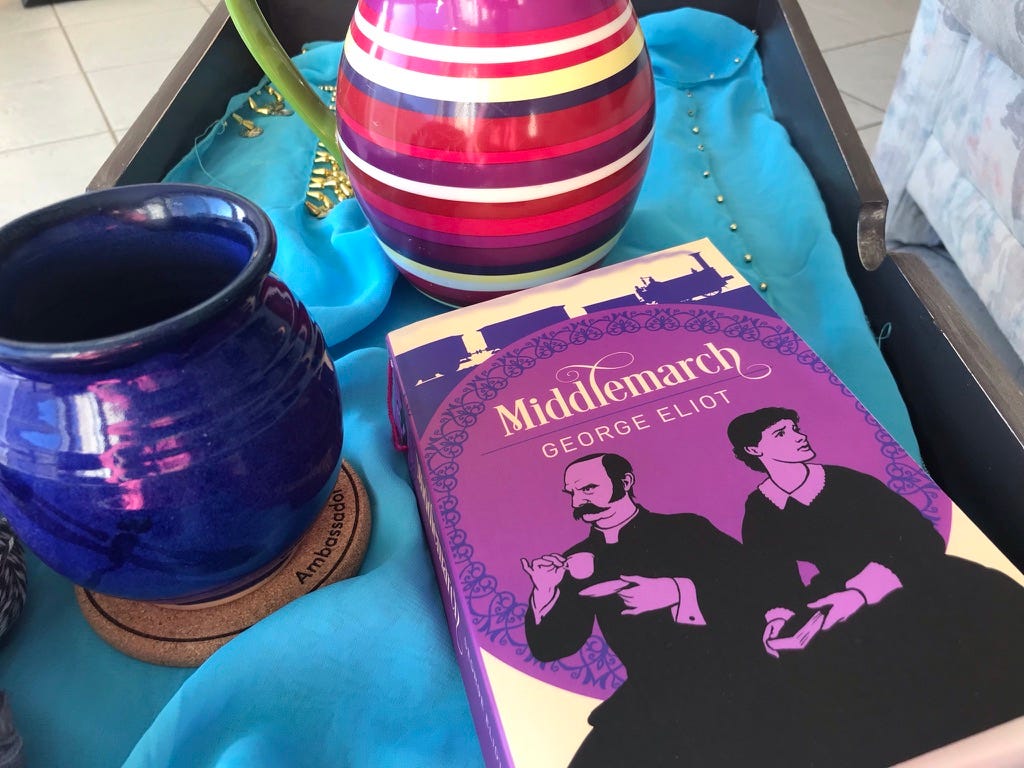
Last year, in a post called Passion Project, 1 I spoke of English gentlemen of the past who spent their days pursuing mad dreams of greatness, because they had no need to labour and earn an income. Casaubon in Middlemarch was my example. I scorned him not only because he was insufferable, but because he hadn’t worked a day in his life. He spent all his time compiling his ‘great work’ The Key to All Mythologies.
As a side note, Mr. Darcy had never worked a day in his life either.
It does seem to be a particularly male thing, even in present times to take on an all-consuming passion project (maybe while ‘the wife’ keeps on cooking, cleaning, and managing the family and financial affairs for her retirement. She might also have a knitting circle she attends once a week – as long as dinner is still on the table when her husband comes out of the garage that houses that ‘classic’ car he is restoring.)
See – this is the picture that comes to mind. These are the characterizations I’m fighting when I think about indulging myself in my own passion projects.
But here’s what I’ve discovered. It’s all in the framing.
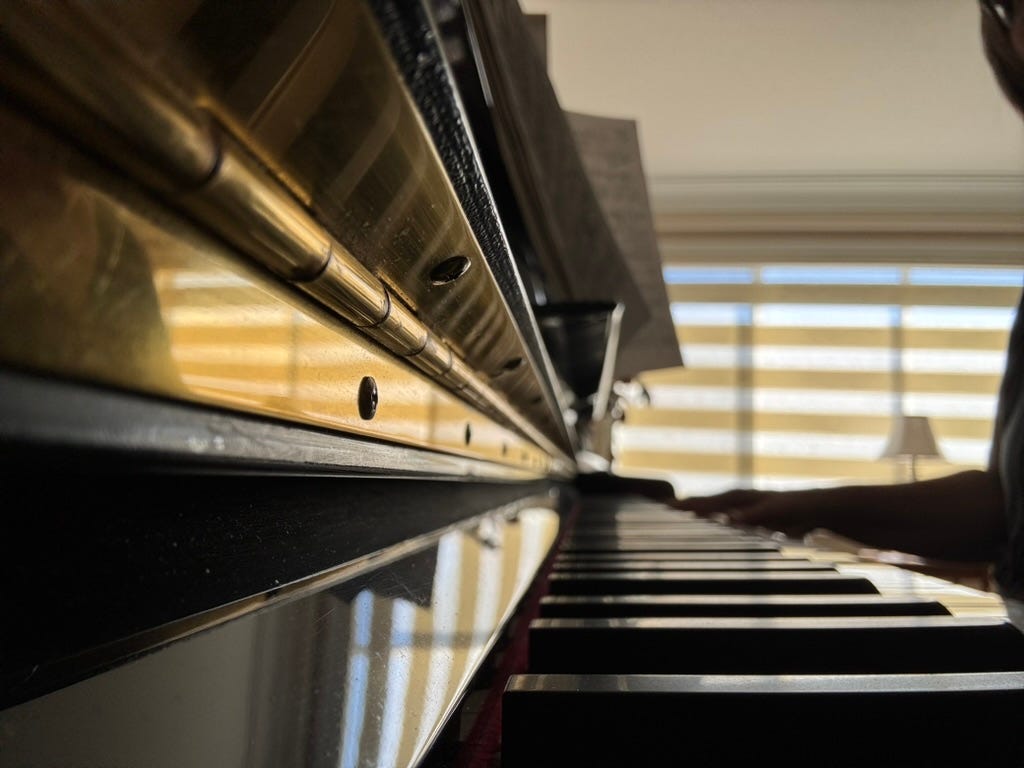
For the last two months I’ve been spending at least 2 hours a day at the piano (you can read more about that here). I’m returning to the piano after a 20 year absence. My days are now filled with Chopin, Brahms, Tchaikovsky and Rachmaninoff – all my favourites from the Romantic period.
It’s a practice that serves absolutely no one but me. My performance days are long past. I will never teach again. This is just me, the art, and the vibration of sound.
Pure self-indulgence.
But when I was a child, learning to play the piano was part of living in my household. Practicing was the same as brushing your teeth or doing your homework. You just did it.
There was no way to know then that I was preparing to make a living from music. I was just learning an important creative skill, chosen for me by my musical parents.
Playing the piano then wasn’t self-indulgence. It was a way to become a better, more disciplined and multi-faceted human. Why is it any different now that I am 58?
Good question.
So what got me thinking about self-indulgence?
I was reading Izabela Shopova’s article entitled We should all write memoirs.
I’ve been writing on Substack for a year now, and, honestly, most of it qualifies as memoir. And I’ve wondered where the value comes from me just talking about my life and my experiences.
I will point out that Izabela does claim that ‘memoir writing is the most effective (and the cheapest) form of therapy’. I think there is real wisdom in that.
But let’s stick, for now, with the idea of self-indulgence. Izabela answers the charge that memoir writing is just self-indulgent.
And the charge of self-indulgence is the wrong way round. The self-indulgent assumption is that your unique, unrepeatable life holds nothing anyone can use. Nobody else stood exactly where you stood. That is the point of being you. Sharing your point of view will help others and will enrich the collective experience of humanity. There is nothing self-indulgent in sharing, teaching, learning and mastering a craft.
~ Izabela Shopova
I will also repeat this story written by Sue Monk Kidd in her excellent book Writing Creativity and Soul:
A few years ago, while in line in a coffee shop, I overheard a woman in front of me say to her friend, ‘I really want to write the memoir, but I can’t get past the feeling it would be self-indulgent.’
Yes, writing memoir is self-indulgent, gloriously self-indulgent, and I’m perfectly okay with that. Women, especially, have been told so many times to be self-less that it can actually feel uncomfortable when we attempt to write one.
I wish I could have told the woman in the coffee shop that one of the gifts and mysteries of writing memoir is that the process not only takes me into myself. It frees me from myself. I realize that sounds incongruous, but if we distill an experience into meaning and then integrate that meaning into our lives through the creation of a narrative, we make it possible to move on without all the preoccupation and unconscious pull of the experience. It’s the unexamined experience that wreaks the most havoc.
~ Sue Monk Kidd from Writing Creativity and Soul
You can find the rest of the story in this footnote. 2
It is also important to note that these words were written in my commonplace book — transcription errors are a possibility.
I know from my experience reading ‘memoir’ written by many of the substack writers that I subscribe to that hearing of their lives and their struggles help me to understand my own.
A few writers that come to mind, who consistently speak to my heart and soul, are Kelly of Benthall Slow Travel, Jada of The Midlife Nomad, and Jennifer of Midlife Anti-Crisis.
I’m also really finding a connection with the work of Sherry Chidwick, Storyteller, Chris Englert (EatWalkLearn), and Dana P. Rowe from Off Book. I’m so happy that these writers choose to write about their lives. Their memoirs might seem self-indulgent to them, but they provide insight and support to me as a human. Thank you for that.
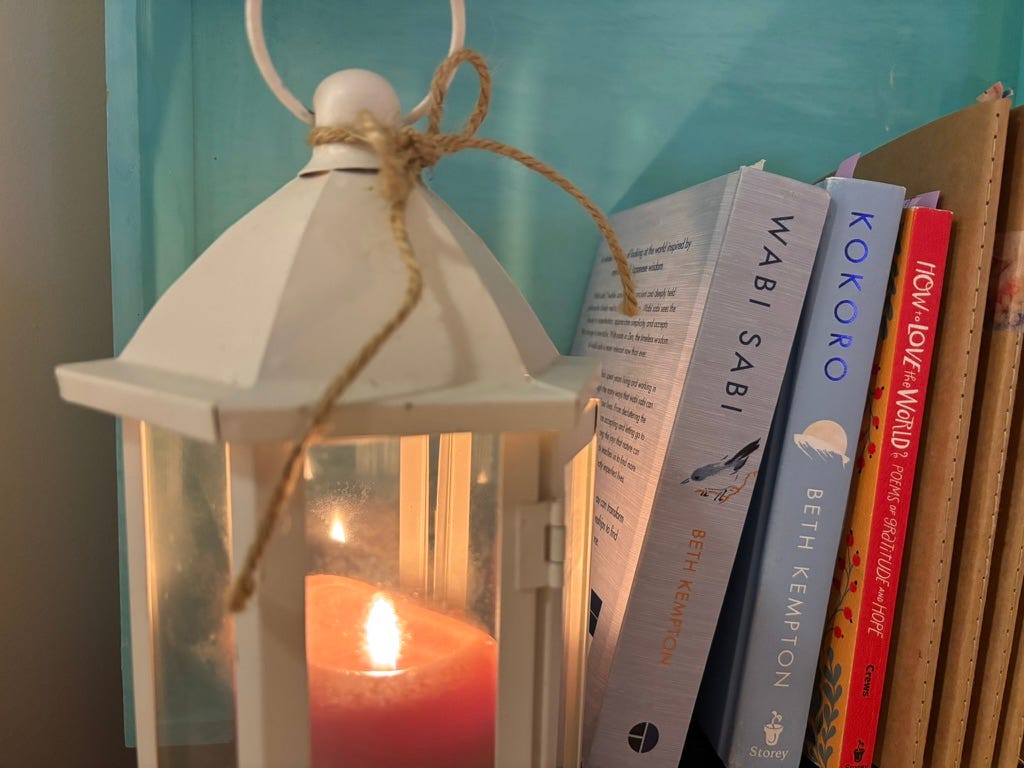
I’ll end with this quote from Beth Kempton, author of many books (which I highly recommend) including Wabi Sabi: Japanese Wisdom for a Perfectly Imperfect Life and Kokoro: Japanese Wisdom for a Life Well Lived. 3
You are a writer. The world needs your medicine.
~ Beth Kempton
If this sounds like an advertisement for Beth Kempton’s SoulCircle, it kind of is. While this email is arriving in your inbox, I’ll be in the middle of a one day virtual writing retreat with Beth entitled The Sea, The Sea.
If you are a writer, or are thinking about embracing the writer’s life, consider joining the SoulCircle writing community.
Embrace some positive self-indulgence. You just might change somebody else’s life with your wisdom.
JL Orr | Paradox & Sea Glass
Based in the Okanagan Valley of British Columbia in Canada
You can also find me at The Travel Paradox.
From May 15, 2025:
Passion project
One of George Eliot’s most unlikeable characters in her 1871 masterpiece Middlemarch is Edward Casaubon, an insufferable and pompous middle-aged scholar who spends his whole life compiling his ‘masterwork’, Key to All Mythologies.
Being a ‘gentleman’ with an annual income means that he can become obsessed with an endless project with no purpose. Retirement, if you are comfortable, can provide a similar opportunity.
I’m imagining retired men in the workshops or retired women with a bit more time for their quilting projects. There are also couples who sail around the world, or walk the Appalachian Trail.
And some people, I imagine, actually embark on the work they’ve wanted to do, or were meant to do, their whole lives. Why wouldn’t you, if you were able.
I can fill most of my waking hours almost any way I want. I can spend the next 5 years researching a topic for no reason other than I am interested. I am also not restricted to researching only from books.
I can go as far down each rabbit hole as I like.
I just need to ensure that I don’t turn into Casaubon…
It may also surprise the woman in the coffee shop as much as it surprised me to discover that writing memoir can also be gloriously other-indulgent. The irony is that the deeper you delve into your own individual story, the more likely you are to tap into a universal truth, to hear the reader say, ‘I didn’t have the experience you wrote about, but I feel like you told my story.’ Now that is a mystery. One that can be a deeply clarifying, validating, even meaning-making experience for a reader.
I would add that memoir is also the author’s movement toward self-understanding, transformation, and meaning. It’s by exploring this movement that we find not only our own wholeness, but the shared meaning of our humanity.
I also recommend The Way of the Fearless Writer: Mindful Wisdom for a Flourishing Writing Life which I have listened to many times. I now hav my own copy, and intended to do a deep read with journalling in the near future. I also did this with Wabi Sabi and Kokoro. And I’ve yet to read Freedom Seeker: Live more. Worry less. Do what you love., but it is sitting in my TBR pile right now.
Thank you for your kind words. I am so happy that you found in my writing the encouragement and permission to self-indulge. Yes, writing is self-indulgent. But so is everything else. If I enjoy cooking, it becomes a self-indulgence, even if I actually cook for others. And if I serve others, but enjoy doing it, it also becomes a self-indulgence.
Your piano practice story resonated deeply with me. Years ago, I also played piano as an act of self-indulgence, but it was also a guilty secret pleasure. I was a very busy wife, mother, and professional and didn't have a spare minute for myself, so this was my only me time and I made an effort to hide it from everyone in order to protect it. I would come back home during my lunch break, when my husband and daughter were at work and school, and I would play for an hour, going through the music pieces I had played as a young girl. It was a wonderful experience mastering these pieces, learning new ones, and remembering my love for music. It made me happy, and I grew addicted to this secret me time. One day, as I played, the door of the room opened, and my mother-in-law and father-in-law walked in. Turned out they had arrived earlier for the dinner we had invited them to (they had a key), and while resting in the guest room, they enjoyed my piano concert. I was embarrassed - my guilty secret had been discovered. But they were so genuinely happy; their eyes shone with tears. They were simple country people who had never spent money on art or concerts. For them, my impromptu piano concert was an incredible privilege to have been treated with a beautiful art experience. Since that day, they would regularly ask me to play for them whenever they visited. So, it turned out that my most guilty self-indulgence served someone else's needs.
This is why I don't believe that anything is self-indulgent. Whatever we do, it always serves someone other than us. Because we are social creatures and we exist through our relationships with the world. Whenever we do something that's good for us, it makes the world a better place.
Thank you for sharing your thoughts. You reminded me of a forgotten passion I once had that I migth revive again.
That’s interesting about self-indulgence. I sometimes feel guilty when I write about myself. What I have learned from a decade of blogging and then writing infrequently on Substack that the world is full of people with similar problems, triumphs and interests as I have. Memoir writing or writing about oneself is just another means of connecting with the tribe.